Monsanto’s Dirty Dozen
So, America! With friends like Monsanto, who needs enemies? (See below for link to original post.)

When you take a moment to reflect on the history of product development at Monsanto, what do you find? Here are twelve products that Monsanto has brought to market. See if you can spot the pattern…

#1 – Saccharin
Did you know Monsanto got started because of an artificial sweetener? John Francisco Queeny founded Monsanto Chemical Works in St. Louis, Missouri with the goal ofproducing saccharin for Coca-Cola. In stark contrast to its sweet beginnings, studies performed during the early 1970s,* including a study by the National Cancer Institute in 1980, showed that saccharin caused cancer in test rats and mice.
After mounting pressure from consumers, the Calorie Control Council, and manufacturers of artificial sweeteners and diet sodas, along with additional studies (several conducted by the sugar and sweetener industry) that reported flaws in the 1970s studies, saccharin was delisted from the NIH’s Carcinogen List. A variety of letters from scientists advised against delisting; the official document includes the following wording to this day: “although it is impossible to absolutely conclude that it poses no threat to human health, sodium saccharin is not reasonably anticipated to be a human carcinogen under conditions of general usage as an artificial sweetener.” (*Read the Chemical Heritage Foundation’s History of Saccharin here.)

#2 – PCBs
During the early 1920s, Monsanto began expanding their chemical production into polychlorinated biphenyls (PCBs) to produce coolant fluids for electrical transformers, capacitors, and electric motors. Fifty years later, toxicity tests began reporting serious health effects from PCBs in laboratory rats exposed to the chemical.
After another decade of studies, the truth could no longer be contained: the U.S. Environmental Protection Agency (EPA) published a report citing PCBs as the cause of cancer in animals, with additional evidence that they can cause cancer in humans. Additional peer-reviewed health studies showed a causal link between exposure to PCBs and non-Hodgkin Lymphoma, a frequently fatal form of cancer.
In 1979, the United States Congress recognized PCBs as a significant environmental toxin and persistent organic pollutant, and banned its production in the U.S. By then Monsanto already had manufacturing plants abroad, so they weren’t entirely stopped until the Stockholm Convention on Persistent Organic Pollutants banned PCBs globally in 2001.
And that’s when Monsanto’s duplicity was uncovered: internal company memos from 1956 surfaced, proving that Monsanto had known about dangers of PCBs from early on.
In 2003, Monsanto paid out over $600 million to residents of Anniston, Alabama, who experienced severe health problems including liver disease, neurological disorders and cancer after being exposed to PCBs — more than double the payoff that was awarded in the case against Pacific Gas & Electric made famous by the movie “Erin Brockovich.”
And yet the damage persists: nearly 30 years after PCBs have been banned from the U.S., they are still showing up in the blood of pregnant women, as reported in a 2011 study by the University of California San Francisco; while other studies are indicating a parallel between PCBs and autism.

#3 – Polystyrene
In 1941, Monsanto began focusing on plastics and synthetic polystyrene, which is still widely used in food packaging and ranked 5th in the EPA’s 1980s listing of chemicalswhose production generates the most total hazardous waste.
#4 – Atom bomb and nuclear weapons
Shortly after acquiring Thomas and Hochwalt Laboratories, Monsanto turned this division into their Central Research Department. Between 1943 to 1945, this department coordinated key production efforts of the Manhattan Project—including plutonium purification and production and, as part of the Manhattan Project’s Dayton Project, techniques to refine chemicals used as triggers for atomic weapons (an era of U.S. history that sadly included the deadliest industrial accident).

#5 – DDT
In 1944, Monsanto became one of the first manufacturers of the insecticide DDT to combat malaria-transmitting mosquitoes. Despite decades of Monsanto propaganda insisting that DDT was safe, the true effects of DDT’s toxicity were at last confirmed through outside research and in 1972, DDT was banned throughout the U.S.
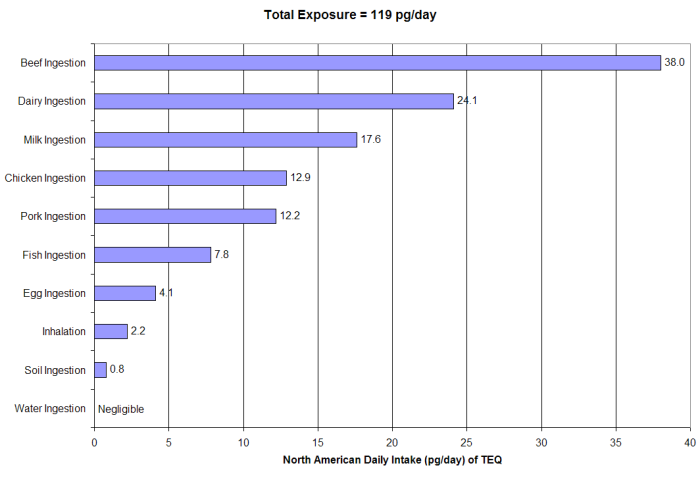
This chart illustrates how much dioxin an average American consumes per day
#6 – Dioxin
In 1945, Monsanto began promoting the use of chemical pesticides in agriculture with the manufacture of the herbicide 2,4,5-T (one of the precursors to Agent Orange), containing dioxin. Dioxins are a group of chemically-related compounds that since become known as one of the “Dirty Dozen” — persistent environmental pollutants that accumulate in the food chain, mainly in the fatty tissue of animals. In the decades since it was first developed, Monsanto has been accused of covering up or failing to report dioxin contamination in a wide range of its products.
 #7 – Agent Orange
During the early 1960s, Monsanto was one of the two primary manufacturers of Agent Orange, an herbicide / defoliant used for chemical warfare during the Vietnam War. Except Monsanto’s formula had dioxin levels many times higher than the Agent Orange produced by Dow Chemicals, the other manufacturer (which is why Monsanto was the key defendant in the lawsuit brought by Vietnam War veterans in the United States).
(Pictured at left, Anh and Trang Nhan, with their father, when they first arrived at the Hoi An Orphanage; below are the same brothers shortly before Trang’s death. Source: Kianh Foundation Newsletter, Dec. 2011)
 As a result of the use of Agent Orange, Vietnam estimates that over 400,000 people were killed or maimed, 500,000 children were born with birth defects, and up to 1 million people were disabled or suffered from health problems—not to mention the far-reaching impact it had on the health of over 3 million American troops and their offspring.
 Internal Monsanto memos show that Monsanto knew of the problems of dioxin contamination of Agent Orange when it sold it to the U.S. government for use in Vietnam. Despite the widespread health impact, Monsanto and Dow were allowed to appeal for and receive financial protection from the U.S. government against veterans seeking compensation for their exposure to Agent Orange.
In 2012, a long 50 years after Agent Orange was deployed, the clean-up effort has finally begun. Yet the legacy of Agent Orange, and successive generations of body deformities, will remain in orphanages throughout VietNam for decades to come.
(Think that can’t happen here? Two crops were recently genetically engineered to withstand a weedkiller made with one of the major components of Agent Orange, 2,4-D, in order to combat “super weeds” that evolved due to the excessive use of RoundUp.)

8 – Petroleum-Based Fertilizer
In 1955, Monsanto began manufacturing petroleum-based fertilizer after purchasing a major oil refinery. Petroleum-based fertilizers can kill beneficial soil micro-organisms, sterilizing the soil and creating a dependence, like an addiction, to the synthetic replacements. Not the best addiction to have, considering the rising cost and dwindling supply of oil…

#9 – RoundUp
During the early 1970s, Monsanto founded their Agricultural Chemicals division with a focus on herbicides, and one herbicide in particular: RoundUp (glyphosate). Because of its ability to eradicate weeds literally overnight, RoundUp was quickly adopted by farmers. Its use increased even more when Monsanto introduced “RoundUp Ready” (glyphosate-resistant) crops, enabling farmers to saturate the entire field with weedkiller without killing the crops.
While glyphosate has been approved by regulatory bodies worldwide and is widely used,concerns about its effects on humans and the environment persist. RoundUp has been found in samples of groundwater, as well as soil, and even in streams and air throughout the Midwest U.S., and increasingly in food. It has been linked to butterfly mortality, and the proliferation of superweeds. Studies in rats have shown consistently negative health impacts ranging from tumors, altered organ function, and infertility, to cancer and premature death; click here to find countless study references to support these statements.
#10 – Aspartame (NutraSweet / Equal)
An accidental discovery during research on gastrointestinal hormones resulted in a uniquely sweet chemical: aspartame. During the clinical trials conducted on 7 infant monkeys as part of aspartame’s application for FDA approval, 1 monkey died and 5 other monkeys had grand mal seizures—yet somehow aspartame was still approved by the FDA in 1974. In 1985, Monsanto acquired the company responsible for aspartame’s manufacture (G.D. Searle) and began marketing the product as NutraSweet. Twenty years later, the U.S. Department of Health and Human Services released a report listing 94 health issues caused by aspartame. (Watch a quick video here.)

#11 – Bovine Growth Hormone (rBGH)
This genetically modified hormone was developed by Monsanto to be injected into dairy cows to produce more milk. Cows subjected to rBGH suffer excruciating pain due to swollen udders and mastitis, and the pus from the resulting infection enters the milk supplyrequiring the use of additional antibiotics. rBGH milk has been linked to breast cancer,colon cancer, and prostate cancer in humans.

#12 – Genetically Modified Crops / GMOs
In the early 1990s, Monsanto began gene-splicing corn, cotton, soy, and canola with DNA from viruses and bacteria in order to achieve one of two traits: an internally-generated pesticide (the corn or soy causes the insect’s stomach to rupture if they eat it), or an internal resistance to Monsanto’s weedkiller RoundUp (enabling farmers to drench their field with RoundUp to kill ever-stronger weeds).
Despite decades of promises that genetically engineered crops would “feed the world” with “more nutrients,” drought resistance, or yield, the majority of Monsanto’s profits are from seeds that are engineered to tolerate Monsanto’s RoundUp—providing them with an ever-increasing, dual income stream as weeds continue to evolve resistance to RoundUp.
Most sobering however, is that the world is once again buying into Monsanto’s “safe” claims.
Just like the early days of PCBs, DDT, Agent Orange, Monsanto has successfully fooled the general public and regulatory agencies into believing that RoundUp, and the genetically modified crops that help sell RoundUp, are “safe.” Despite the fact that NO human testing has ever been done on GMO crops!
Meanwhile, Monsanto has learned a thing or two in the past 100+ years of defending its dirty products: these days, when a new study shows the negative health or environmental impacts of GMOs, Monsanto attacks the study and its scientist(s) by flooding the media with counter claims from “independent” organizations, scientists, industry associations, blogs, sponsored social media, and articles by “private” public relations firms—all endorsed, founded, funded or maintained by Monsanto.
Unfortunately, few of us take the time to trace the members, founders, and relationships of these seemingly valid sources back to their little Monsanto secret. (Read more on this page.)
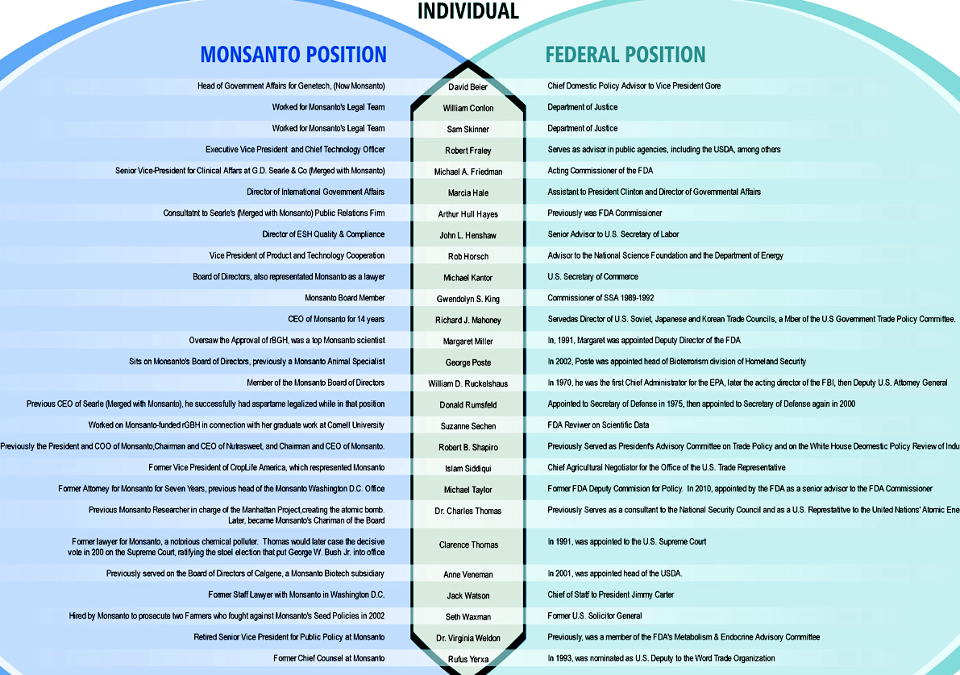
Fooling the FDA required a slightly different approach: click on the below chart compiled by Millions Against Monsanto to see how many former Monsanto VPs and legal counsel are now holding positions with the FDA. And don’t forget Clarence Thomas, former Monsanto attorney who is now a Supreme Court Justice, ruling in favor of Monsanto in every case brought before him.
A Baker’s Dozen: #13 – Terminator Seeds
In the late 1990s, Monsanto developed the technology to produce sterile grains unable to germinate. The goal of these “Terminator Seeds” was to force farmers to buy new seeds from Monsanto year after year, rather than save and reuse the seeds from their harvest as they’ve been doing throughout centuries.
Fortunately this technology never came to market. Instead, Monsanto managed to accomplish the same thing by requiring farmers to sign a binding contract agreeing that they will not save or sell seeds from year to year, which forces them to buy new seeds and preempts the need for a “terminator gene.” Lucky for us… since the terminator seeds were capable of cross-pollination and could have contaminated local non-sterile crops.

What’s the Result of our Monsanto Legacy?
Between 75% to 80% of the processed food you consume every day has GMOs inside, and residues of Monsanto’s RoundUp herbicide outside. But it’s not just processed food—fresh fruit and vegetables are next: genetically engineered sweet corn is already being sold at your local grocer, with apples and a host of other “natural” produce currently in field trials.
How is it that Monsanto is allowed to manipulate our food after such a dark product history? How is it they are allowed to cause such detrimental impact to our environment and our health?
According to the Organic Consumers Association, “There is a direct correlation between our genetically engineered food supply and the $2 trillion the U.S. spends annually on medical care, namely an epidemic of diet-related chronic diseases.
Instead of healthy fruits, vegetables, grains, and grass-fed animal products, U.S. factory farms and food processors produce a glut of genetically engineered junk foods that generate heart disease, stroke, diabetes and cancer—backed by farm subsidies—while organic farmers receive no such subsidies.
Monsanto’s history reflects a consistent pattern of toxic chemicals, lawsuits, and manipulated science. Is this the kind of company we want controlling our world’s food supply?
P.S. Monsanto’s not alone. Other companies in the “Big Six” include Pioneer Hi-Bred International (a subsidiary of DuPont), Syngenta AG, Dow Agrosciences (a subsidiary of Dow Chemical, BASF (which is primarily a chemical company that is rapidly expanding their biotechnology division), and Bayer Cropscience (a subsidiary of Bayer). The websiteBiofortified.org maintains a complete list of companies doing genetic engineering.
(End of original post)
Shocking, isn't it? You read this and realize how powerful and ubiquitous this company really is, and has been and will be unless WE make different choices. But they appear to have the country by the short hairs, non? Well, Non. Read labels, make informed choices, tell your take out place you won't buy from them if they don't switch to biodegradable packaging, same with coffee cups, no stryofoam or you lose my bidness. Get together with friends, make a list of choices you can all make that don't support this madness, write the company and let them know you're doing that, tell vendors you buy from to do that. It's a start.
Every journey starts with a step. Bon voyage.
above Monsanto article From a posting on www.gmo-awareness.com, click on following date to see original post
above Monsanto article From a posting on www.gmo-awareness.com, click on following date to see original post


